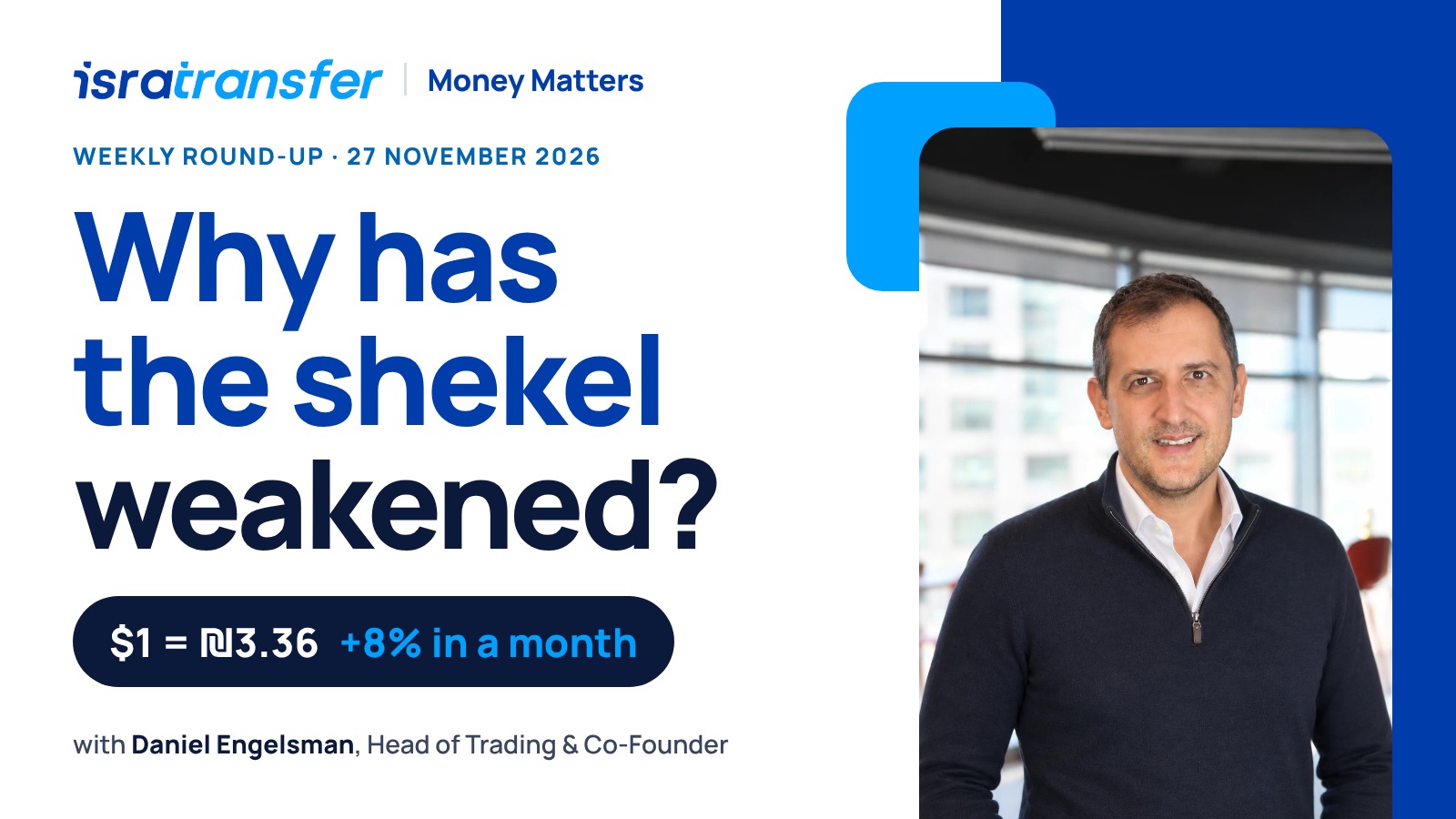
Why Has the Shekel Weakened? | Money Matters with Daniel Engelsman | 27 Nov 2026
 By
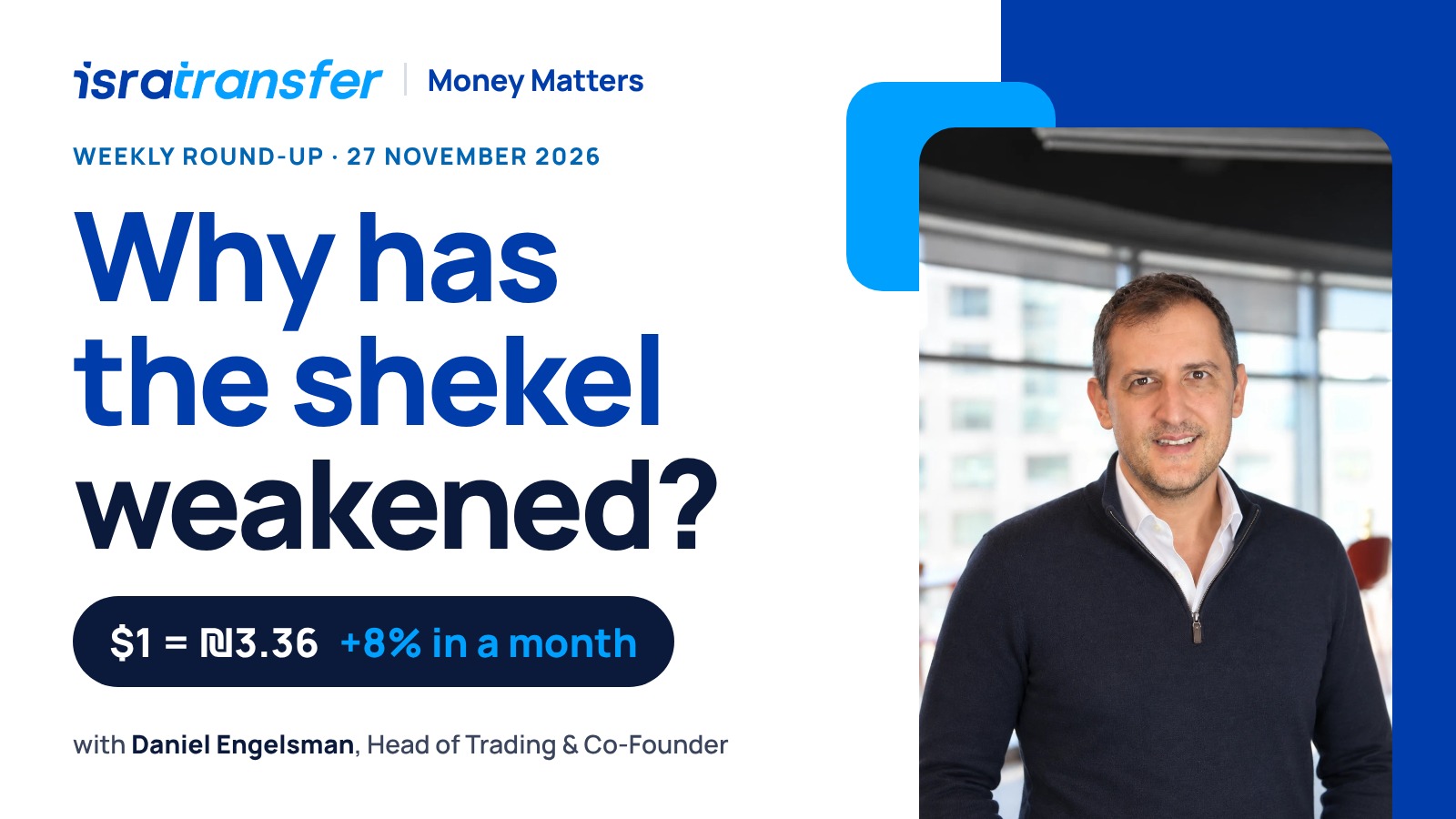 If you have looked at the exchange rate in the last few weeks, you will have noticed that your dollars, pounds or euros now buy a lot more shekels than they did a month ago. On 26 October, one US dollar bought about ₪3.10. This week it touched ₪3.36, a rise of more than 8% in a single month.
In this week's Money Matters, Daniel Engelsman, our Head of Trading and Co-Founder, explains in plain English what has happened and why. He covers the three main reasons behind the move (the politics at home, interest rates, and falling stock markets), why the currencies have not all moved by the same percentage, and what it means if you are bringing money into Israel or sending it out.
Listen to the episode below, or read the full transcript underneath.
Money Matters: Why the Shekel Has Weakened Currency Exchange Weekly Round-Up, 27 November 2026, with Daniel Engelsman, Head of Trading & Co-Founder at IsraTransfer
In this week's Money Matters, Daniel Engelsman, our Head of Trading and Co-Founder, explains in plain English what has happened and why. He covers the three main reasons behind the move (the politics at home, interest rates, and falling stock markets), why the currencies have not all moved by the same percentage, and what it means if you are bringing money into Israel or sending it out.
Watch the episode below, or read the full transcript underneath.
Transcript Host: Welcome to Money Matters, the weekly currency round-up podcast brought to you by IsraTransfer. Whether you're a seasoned investor, an expat managing your finances, or just curious about the world of currency exchange, you're in the right place. Each week, IsraTransfer's co-founder and head of trading, Daniel Engelsman, will inform us of the latest trends, insights, and market movements that could impact your money. From currency fluctuations to economic news, we're here to equip you with everything you need to navigate the ever-changing landscape of foreign exchange. So let's dive into this week's round-up.
Daniel, what's the latest update on the exchange rate?
Daniel Engelsman: If you've looked at the exchange rate in the last few weeks, you will have noticed something. The dollar, the pound, the euro, almost every currency now buys a lot more shekels than it did a month ago. Today, I want to explain in plain English what has happened and why.
Let's start with the numbers. On the 26th of October, one US dollar bought about 3 shekels and 10 agorot. This week, it touched 3.36. That is a rise of more than 8% in a single month. The pound has gone from about 4.14 to almost 4.40. The euro from 3.47 to 3.68. The Canadian dollar from 2.21 to 2.35. Each of those is up around 6%. The Australian dollar has moved the least, from about 2.18 to 2.22, a rise of about 2%.
Let me put that in real terms. A month ago, $100,000 bought about 310,000 shekels. This week, the same $100,000 bought about 336,000. That's 26,000 shekels more for the same money.
Remember where we were in the spring. At the end of May, the dollar was at 2.81, the strongest the shekel had been for about 30 years. Since then, the dollar has climbed by almost 20%.
Host: What are the reasons behind this change?
Daniel Engelsman: There are three main reasons. Number one, the politics at home.
Israel held elections on the 27th of October and it did not produce a clear winner. A month later, we still don't have a new government, and without a new government, there's no approved state budget. Investors can live with good news and they can live with bad news. What they find hardest is not knowing. When they cannot see who will be running the country or what the budget will look like, some of them move money out of shekels and wait. You can see it in the numbers. In the first week after the vote, the shekel lost more than 3% against the dollar.
Reason number two is interest rates.
Here in Israel, the Bank of Israel has held its rate steady at 3.25% at each of its last two decisions. Inflation here is low, just over 1% a year, so there's been no pressure to raise it. Overseas, the picture is different. In America, rates are already higher, between 3.75% and 4%. The markets expect them to go up again, possibly as soon as December. Rises are expected in Europe as well.
Why does it matter for an exchange rate? Think of currency as a savings account. One account pays 3.25%, another pays close to 4% and is about to pay more. Large investors who move billions shift their money to the account that pays more. To do that, they have to sell shekels and buy dollars. More people buying dollars and more people selling shekels pushes the price of the dollar up. Notice that Israel did not need to cut its rate for this to happen. It is the gap that matters. Standing still while others move up is enough to make the gap wider. This is also a big part of why the dollar has been rising against most currencies around the world, not only the shekel. It is at its strongest for more than a year and a half.
Reason number three, the falling stock markets.
The third reason is the one that most people have never heard of, and it may be the biggest. Israeli pension and savings funds hold enormous sums in shares abroad, mostly in America. When Wall Street falls, as it has over the last few weeks, those funds have to rebalance. In practice, that means they buy dollars and sell shekels in very large amounts. So the shekel and Wall Street tend to move together. When American shares fall, the shekel usually weakens. In the spring it worked the other way around. Shares were rising and the shekel rose with them.
Host: Why have the currencies not all moved at the same percentage?
Daniel Engelsman: You might be wondering why the dollar is up 8%, the pound and euro 6, and the Australian dollar only 2. The answer is that two things are happening at once. The shekel has weakened against everything, and on top of that, the dollar has strengthened against everything. Put those together and the dollar shows the biggest rise. The Australian dollar is the opposite case. It tends to weaken when the world's stock markets fall, so it's been under pressure too. Against the shekel, the two have almost cancelled each other out.
Host: And finally, any advice for those looking to exchange funds over the coming weeks?
Daniel Engelsman: If you're bringing money into Israel from a pension, a property sale or savings abroad, your dollars, pounds or euros buy noticeably more shekels than they did a month ago. If you're sending money the other way, from shekels to another country, it now costs you more.
The question everyone asks next is, where does it go from here? The honest answer is that nobody knows. A new government, the decision on American interest rates, a good or bad week on Wall Street, potential war with Iran, any of these could move the rate in either direction, and quickly. This week alone, the shekel moved about 1% in a single day.
If you have a transfer coming up, a property payment, a regular transfer to family or anything else, call us or send us a message. You will speak to a real person who knows your account and who can explain your options. Thank you for listening. I'm Daniel Engelsman from IsraTransfer. Thank you.
Host: And that wraps up this week's Currency Weekly Round-Up. We hope you found this episode informative and engaging. If you enjoyed today's discussion, be sure to subscribe and let us know if you have any questions you'd like Daniel to answer. For more information on currency exchange and to stay updated with the latest trends, visit us at isratransfer.com. Join us next week for more insights and analysis. Until then, stay informed and take care.
Disclaimer: This podcast provides general information about currency exchange and buying or selling currency. It does not constitute legal, financial, or investment advice. Listeners should make independent decisions and seek professional guidance. The company is not liable for any actions taken based on this content.